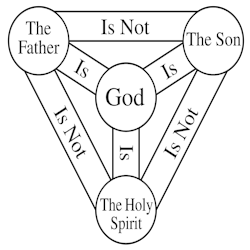
The Trinity
Scriptural Reference:"In no other subject is error more dangerous, inquiry more difficult, or the discovery
of truth more rewarding"
Augustine, De Trinitate"That we worship one God in trinity and the trinity in unity, neither blending their persons nor dividing their essence. For the person of the Father is a distinct person, the person of the Son is another, and that of the Holy Spirit still another. But the divinity of the Father, Son, and Holy Spirit is one, their glory equal, their majesty coeternal"
The Athanasian Creed“After being baptized, Jesus came up immediately from the water; and behold, the heavens were opened, and he saw the Spirit of God descending as a dove and lighting on Him.”
Matthew 3:16“Go therefore and make disciples of all the nations, baptizing them in the name of the Father and the Son and the Holy Spirit . . .”
Matthew 28:19The grace of the Lord Jesus Christ, and the love of God, and the fellowship of the Holy Spirit, be with you all.
2 Corintians 13:14
Reflection:
When it comes to contentious topics the Trinity is right up at the top. The Trinity could be described as a conundrum wrapper in a conundrum and then hidden in a riddle. Factional denominations have built their branding, such as Church of Jesus Christ of Latter-day Saints, Oneness Pentecostals, Jehovah's Witnesses, based on their rejection if the Trinity. While some of these groups purport it be "Christian" or aligned with Christian doctrine; they also tend to reject the Bible as it is. Either choosing to create their own set of holy books or doctrine to adhere to. The Church of Jesus Christ of Latter-day Saints has gone so far as to match Jesus and Lucifer up as brothers. A contentious issue that can be discussed at another time.
What do we know about the Trinity from the bible? We read in Matthew 3:16 how the Spirit of God rested on Jesus after he was baptised. This gives us the impression that Jesus is one person, God is His Father and a separate person and the Holy Spirit is a third personage. The Holy Spirit is described as coming from God and resting on Jesus. Three distinct individuals. And yet we are also told that they are of the same substance and being.
(1) There is exactly one God.
(2) The Father is God, the Son is God and the Holy Spirit is God
(3) The Father is not the Son, and the Holy Spirit is not the Father or the SonAt this point, and in keeping with the Bibles teachings, It's important to remember that Christians are not permitted to deny any of these three points. As explained;
(1) Is intended to rule out polytheism, the view that there is more than one God. As in the Church of Jesus Christ of Latter-day Saints. Where they tend to hide the doctrine that they believe there are multiple god's at work in the universe.
(2) Is intended to rule out subordination-ism, the view that not all of the Persons are divine, or that the divinity of one or more of the Persons is unequal with, or subordinate to, that of the others. As in many gnostic groups who try and rationalise the hierarchy of God and man.
(3) Is intended to rule out modalism, the view that the Persons of the Trinity are not really distinct from one another but merely different manifestations (in Latin, 'modes') in which the one God presents himself. As in the United Pentecostals, and the Oneness Pentecostalism. By denying the Trinity the attempt to nominalise the unique essence of God.I remember reading of one attempt to understand the Trinity. This analogy uses water to create an image of how the three could be unique and yet of the same nature or essence. Oddly this view has been rejected by many modern theologians. It would seem theologians have become very attached to their own opinions over the long held beliefs and understandings of past theologians. Not always a good thing. As for the water analogy; I find it useful. As water has the three forms of solid, fluid and gas, and yet in all three states it is still water. So that within a confined space one could have all three states represented of the same substance.
There is the egg analogy that works on the three aspects of an egg. The shell, the album (white) and the yolk. Each being separate and yet it takes all three to create the egg as we know and recognise it. For me this is problematic. Although the three parts add up to make the whole egg, they are not of the same nature or essence. They are too unique to constitute a being that is both uniquely separate and still bonded as one. There seems to needs there to be a definition of function for each aspect of the Trinity of God while not diminishing the whole. To give each part of the Trinity a purpose and personality unique to them could be to define each as being;
"God the Father o Creator"
"God the Son o Redeemer"
"God the Holy Spirit o Comforter"I believe that we are blessed by the definitions of these three as each provides us with those things we truly need most in life. We are created by God as our Father. We are able to be recognised with God through Jesus the Christ and we find our comfort and guidance through the Holy Spirit. It is in this Holy and Divine conundrum that we find the anchor of our salvation. Where we can meet with God through Jesus and guided by the Holy Spirit. No other mechanism will do what the Trinity can do for our ultimate salvation. This is also why we need to give equal relevance and importance to all three aspects and parts of God. If you are attending a church that doesn't recognise the sanctity of the Trinity you need to leave and seek out one that does. Your very salvation and eternal future relies in it.
Prayer:
Father God devine Creator,
You who knew me before birth.
Take my heart and teach it wisdom,
Help me grow my faith in you.Blessed Lord, my sould salvation,
Healer of thgis broken heart.
Guide me now into your vineyard,
For the harvest of your love.Holy Spirit, precious comfort,
Guiding light within my heart.
Gently lead me ever onward,
To the mystery of the Cross.Amen